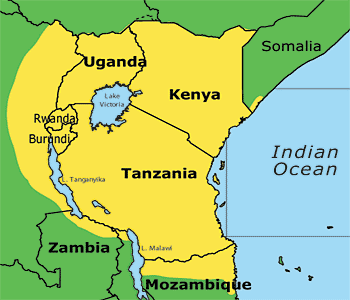
Recent remarks by President William Ruto during his visit to Tanzania sparked widespread debate among Kiswahili enthusiasts across East Africa. In a humorous reflection, the Kenyan president suggested that Kiswahili was born in Zanzibar, developed in Tanzania, became weak in Kenya, struggled in Uganda and eventually “died” in Congo.
Although the statement was delivered jokingly, it generated significant public discussion concerning the current status of Kiswahili in the East African region. The remarks raised an important question if East Africa has done enough to protect and promote Kiswahili as a unifying African language?
To a large extent, the president’s sentiments reflected the differing levels of commitment that East African states have shown toward Kiswahili. Tanzania remains the strongest example of successful language preservation and promotion.
Since independence under the leadership of Mwalimu Julius Nyerere, Tanzania adopted Kiswahili as a national language to strengthen unity among its many ethnic groups. The language became central in education, governance, media and national identity. As a result, Kiswahili in Tanzania enjoys prestige and widespread acceptance across social classes.
In contrast, Kenya presents a more complex situation. Although Kiswahili is recognized constitutionally as both a national and official language and was really born in its coastal region, English continues to dominate formal communication, higher education and professional institutions. In many urban settings, fluency in English is associated with social status and educational achievement, while Kiswahili is often perceived as less prestigious.
This attitude has weakened the language’s influence among younger generations, particularly in elite social environments. Nevertheless, Kenya has also made considerable contributions to Kiswahili through media, literature, music and regional communication.
The situation in Uganda and the Democratic Republic of the Congo further demonstrates the uneven development of Kiswahili in the region. Uganda historically associated Kiswahili with military rule and state violence during earlier political periods, which limited its social acceptance for decades.
Although the language was later adopted officially within the East African Community framework, its use remains limited in some parts of the country. In Congo, Kiswahili exists mainly in regional variations and competes with French and numerous indigenous languages. Despite this diversity, millions of Congolese continue to use Kiswahili in everyday communication.
While President Ruto’s statement may have exaggerated certain realities, it accurately highlighted the broader challenge facing Kiswahili in East Africa that the language risks losing its cultural prestige unless deliberate measures are taken to protect it.
Kiswahili is a means of communication while it represents a significant symbol of African identity, history and regional unity. As one of the few indigenous African languages with international recognition, Kiswahili has become an important instrument for promoting Pan-Africanism and reducing dependence on colonial languages such as English, French and other foreign languages.
The protection of Kiswahili therefore requires collective responsibility from governments, educational institutions, media organizations and citizens. First, East African governments should strengthen Kiswahili education at all academic levels. The language should not be treated only as a compulsory subject but also as a medium for scholarship, scientific research and technological innovation. Expanding its academic use would increase its relevance in modern society.
Second, digital media and creative industries must promote quality Kiswahili content. Young people increasingly consume information through online platforms, music, films and social media. If Kiswahili is absent in these spaces, foreign languages will continue dominating cultural expression and intellectual engagement.
Third, families and communities should encourage pride in speaking Kiswahili. The belief that English represents intelligence or modernity while African languages symbolize backwardness reflects a lingering colonial mentality that undermines local cultures. Promoting multilingualism can allow citizens to value both international and indigenous languages without diminishing either.
President Ruto’s remarks opened an important conversation about the status of Kiswahili in East Africa. Although humorous, the comments exposed genuine concerns regarding the preservation of the language. Kiswahili remains one of Africa’s greatest cultural assets and a powerful symbol of regional unity. Protecting and promoting it is therefore a linguistic responsibility, a cultural and political necessity for East Africa’s future.