Adamuz, Spain is reeling after a catastrophic high-speed train collision on Sunday evening claimed the lives of at least 40 people and left dozens more injured, marking one of the country’s deadliest rail disasters in more than a decade.
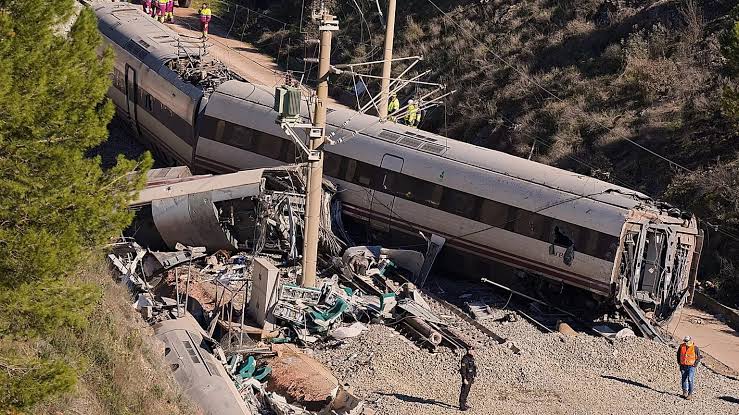
The crash occurred on 18 January 2026, near the town of Adamuz in Córdoba province, when a passenger train travelling from Málaga to Madrid derailed and veered onto an adjacent track, colliding with another train heading from Madrid to Huelva. The impact caused multiple carriages to derail, with some plunging down a nearby slope.
Emergency services said the collision happened at approximately 7:45 p.m. local time, prompting a large-scale rescue operation involving firefighters, paramedics, police, and military personnel.
Casualties and rescue efforts
Authorities have confirmed at least 40 fatalities, though officials warn the number could rise as recovery operations continue. More than 50 passengers were injured, several of them critically, and were transported to hospitals across the Andalusia region.
Rescue workers described scenes of devastation, with crushed carriages, twisted metal, and passengers trapped inside the wreckage. Heavy machinery was later brought in to assist with search and recovery efforts.
One of the most poignant stories to emerge from the disaster is that of a six-year-old girl, reported to be the sole survivor of her family, an account that has deeply touched the Spanish public.
Investigation into the cause
The exact cause of the crash remains under investigation. Preliminary findings point to a possible failure in the rail infrastructure, with investigators examining a broken rail joint discovered near the derailment site. Officials have indicated that human error and excessive speed are not currently suspected.
The accident occurred on a straight section of track that had recently undergone maintenance, intensifying scrutiny over inspection and safety procedures. Spain’s Commission for the Investigation of Rail Accidents (CIAF) has launched a formal inquiry, cautioning that a full report may take several months to complete.
Government and national response
Prime Minister Pedro Sánchez visited the crash site and met with emergency responders and victims’ families. He offered condolences on behalf of the government and pledged a transparent investigation into the disaster.
In response, the Spanish government declared three days of national mourning, with flags lowered across public institutions nationwide.
“This is a tragedy that has shaken our country,” Sánchez said. “Our priority is to support the victims and ensure the truth is fully established.”
Safety concerns raised
Spain operates one of the largest and most modern high-speed rail networks in Europe, where serious accidents are rare. The scale of this collision has reignited debate about infrastructure oversight, maintenance standards, and passenger safety.
As Spain mourns the victims, attention now turns to the investigation, and to preventing a tragedy of this magnitude from ever happening again.