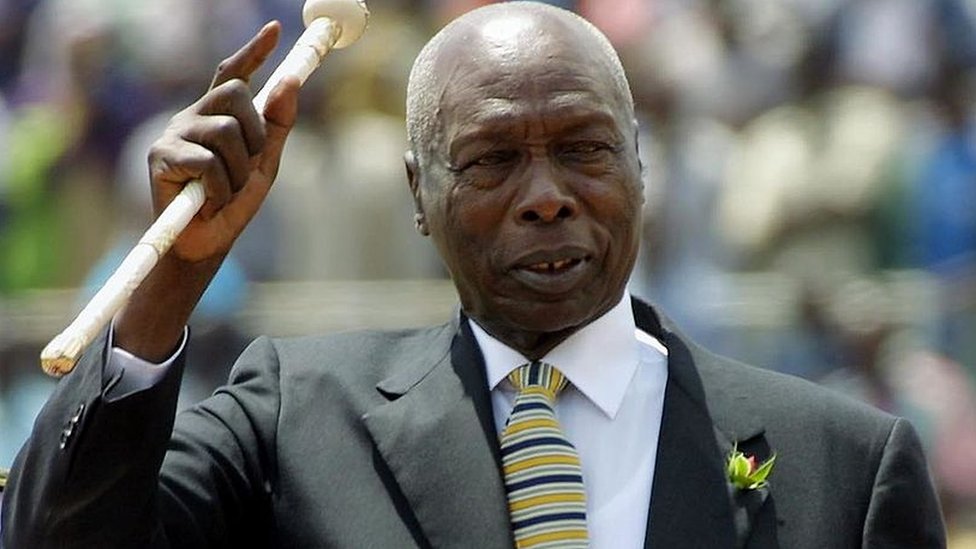
Daniel Toroitich arap Moi, Kenya’s longest-serving president, continues to occupy a unique place in the nation’s memory. Even after his death in February 2020, his name evokes strong emotions, admiration, nostalgia and debate. Moi’s legacy is not simply about the length of his rule but about the way he shaped Kenya’s political culture, national identity and regional standing. His philosophy of Nyayo, meaning peace, love and unity, remains a defining feature of how Kenyans remember him and it explains why his image endures as iconic.
Moi rose to power in 1978 after the death of Jomo Kenyatta, inheriting a young nation still finding its footing. For 24 years, he presided over Kenya, becoming a constant presence in the lives of citizens. His longevity in office made him synonymous with leadership itself. Generations grew up knowing Moi as the face of authority, a figure who embodied continuity in a region often marked by instability. This alone cemented his place in history, but it was his ability to keep Kenya relatively stable during turbulent times that elevated his stature further.
Moi consistently urged Kenyans to embrace peace, love and unity, positioning himself as a father figure who sought to bridge ethnic divides. In a country with diverse communities, this message resonated deeply. It became a rallying cry for national cohesion and even today, politicians invoke Moi’s words when calling for unity. His emphasis on harmony helped Kenya avoid the kind of ethnic violence and fragmentation that plagued many of its neighbours.
Moi’s influence extended beyond Kenya’s borders. He was respected as a regional statesman, chairing the Organization of African Unity between 1981 and 1983. His diplomatic efforts positioned Kenya as a voice of moderation in Africa. At a time when Uganda, Sudan and Somalia were engulfed in turmoil, Moi’s Kenya stood out as a relatively peaceful nation. This reputation for stability reinforced his image as a guardian of peace across East Africa.
The scale of Moi’s farewell in 2020 demonstrated the depth of his impact. His death was marked by a state funeral attended by thousands of Kenyans and dignitaries from across the region. A public holiday was declared and citizens travelled long distances to pay their respects. The outpouring of emotion revealed that Moi was a symbol of an era. His passing reminded Kenyans of the power of leadership to unify and to leave footprints that endure long after the leader himself is gone.
Undeniably, Moi’s legacy is complex. His administration faced accusations of authoritarianism, suppression of dissent and economic mismanagement. Critics argue that his long rule stifled democratic growth. Yet, the fact that he is still remembered with reverence highlights the paradox of leadership that one can be both criticized and celebrated yet remain iconic. Moi’s ability to command loyalty and respect, even in retirement, underscores his enduring influence. His image as a father of the nation persists, despite the controversies.
Ultimately, Moi continues to be remembered as iconic because he embodied stability, unity and symbolism at a time when Kenya needed them most. His philosophy of Nyayo remains alive in national discourse and his long tenure ensures that his imprint on Kenya’s political and social fabric is indelible. While debates about his governance persist, the continued invocation of his ideals proves that Moi’s legacy is a living memory.
In remembering Moi, Kenyans are reminded of the power of leadership to unify, to symbolize hope and to shape the destiny of a nation. His story is a reminder that iconic leaders are not defined solely by perfection but by the depth of their influence and the way they continue to inspire long after they are gone.