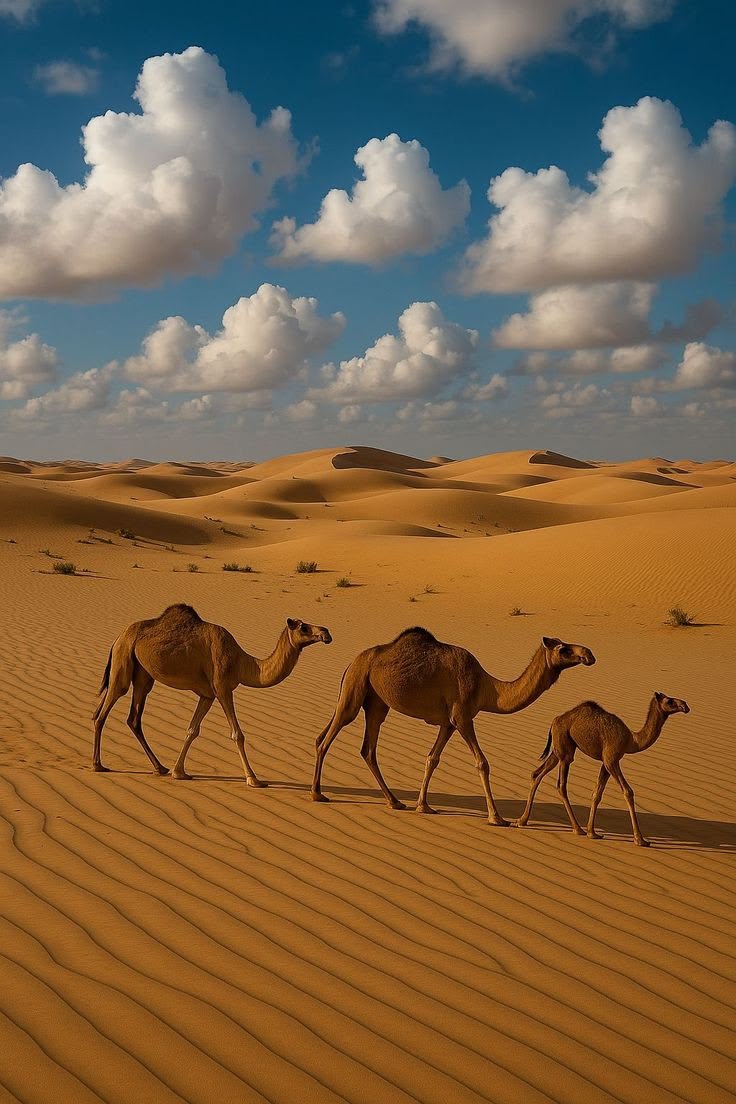
Camels are some of the most fascinating animals on Earth. When people think about deserts, they often picture endless sand, a hot sun, and a tall animal walking slowly across the horizon. That animal is usually a camel. Camels are strong, patient, and perfectly designed for some of the hardest living conditions in the world.
Camels are large mammals, which means they are warm-blooded and feed their young with milk. They belong to a group of animals specially adapted to dry places. There are two main types of camels alive today. One is the dromedary camel, which has one hump and is common in Africa and the Middle East. The other is the Bactrian camel, which has two humps and lives in parts of Central Asia where deserts can even get very cold. While many people think deserts are always hot, some deserts become freezing at night or during winter, and camels are able to handle both heat and cold.
One of the most interesting parts of a camel’s body is its hump. Many people grow up believing that camels store water in their humps, but that is not true. The hump actually stores fat. This fat acts like a food reserve. When a camel cannot find enough to eat, its body uses the fat for energy. As the fat is used up, the hump can shrink and even lean to one side. When the camel eats well again, the hump slowly fills back up. Storing fat in one place instead of all over the body also helps the camel stay cooler under the hot desert sun.
Camels are famous for surviving long periods without water. In very dry conditions, a healthy adult camel can go several days, sometimes even longer, without drinking. When it finally finds water, it can drink a very large amount in a short time. Their bodies are specially designed to prevent water loss. They sweat less than many other animals, and their kidneys are very efficient at keeping as much water as possible inside the body. Even their red blood cells have a special shape that allows them to keep flowing smoothly when the camel is dehydrated.
Everything about a camel seems designed for desert life. Its long eyelashes protect its eyes from blowing sand. It even has a third eyelid that helps shield the eye during sandstorms. Its nostrils can close tightly to keep sand out. The feet of a camel are wide and flat with thick pads underneath. This helps it walk easily on soft sand without sinking. Instead of hooves like cows or horses, camels have two toes on each foot, and the soft padding spreads out when they step down, giving them balance.
Camels are herbivores, which means they eat plants. In the desert, plants are not always soft and green. Many are dry, thorny, or salty. Camels are not picky eaters. They can chew tough bushes and dry grass that other animals would avoid. Their mouths are strong and lined in a way that protects them from sharp thorns. Inside, their stomachs are built to break down rough plant material and get as much nutrition as possible from it.
For thousands of years, camels have been closely connected to human life. In many parts of Africa and Asia, they are not just animals but partners in survival. They carry goods and people across long desert journeys, sometimes walking for many kilometers in a single day. Before modern vehicles, camels were the main way traders moved salt, spices, cloth, and other goods across deserts. Because of this, they were often called “ships of the desert.” Even today, in areas where roads are poor or fuel is expensive, camels remain important for transport.
Camels also provide milk, which is very important in many dry regions. Camel milk is rich in nutrients and can stay fresh longer than cow’s milk in hot weather. In some communities, camel milk is a daily part of meals. Camel meat is also eaten in certain cultures, and their hair is used to make ropes, blankets, and tents. Almost every part of the animal can be useful.
Despite their calm appearance, camels can move quickly. They can run fast for short distances if they feel threatened. However, they are generally known for their slow and steady walk. They are social animals and often travel in groups. A baby camel, called a calf, can stand and walk within hours after being born. Camels can live for around forty to fifty years if they are well-cared for.
Today, camels are still very important, especially in regions facing climate change and drought. As some areas become hotter and drier, camels are sometimes seen as more reliable than other livestock because they need less water and can survive on tougher plants. In countries like Kenya, Somalia, and parts of the Middle East, camel farming is growing for this reason. What once seemed like an animal only for the desert is now seen as part of the future in dry lands.
When you look at a camel, with its long legs, tall neck, and steady eyes, it may seem simple at first. But every part of its body tells a story of survival. Camels remind us that life can adapt in powerful ways. In places where many animals would struggle to survive, camels continue to walk calmly across the sand, carrying not just loads on their backs, but also centuries of history alongside human communities.