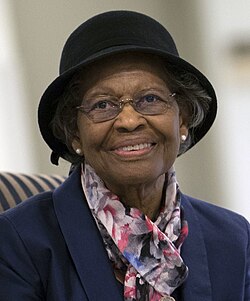
Humble Beginnings and a Determined Mind
Gladys Mae West was born on October 27, 1930, in rural Sutherland County, Virginia. Raised on a farm, she witnessed early how physically demanding life could be and quickly understood that education was her path to a different future. Determined to escape farm labor, she excelled academically and graduated as valedictorian, earning a scholarship to attend college.
She studied mathematics at Virginia State College, now Virginia State University, one of the few institutions at the time that provided Black students access to advanced education. Her passion for numbers and problem solving later led her to earn a Master’s degree in Mathematics from the University of Oklahoma.
Breaking Barriers in Science
In 1956, Gladys West joined the U.S. Naval Surface Warfare Center in Dahlgren, Virginia. She entered a professional space where women were rare and Black women even rarer. Despite the barriers of race and gender, West distinguished herself through precision, discipline, and intellectual excellence.
Her work focused on satellite geodesy, the science of measuring and understanding the Earth’s true shape using satellite data. At a time when computers were enormous and programming was painstakingly manual, West processed massive datasets and performed complex calculations that few others could manage.
The Mathematics Behind GPS
The Earth is not a perfect sphere, and even small miscalculations can lead to large errors in navigation. Gladys West specialized in refining mathematical models of the Earth’s surface, known as geoid models. Her work helped determine exact positions on Earth with unprecedented accuracy.
These calculations became a foundational component of satellite navigation systems. Although the technology evolved over time, the accuracy that modern GPS relies on is rooted in the mathematical frameworks West helped develop.
An Impact Felt Across the World
For many years, West’s contributions remained largely unrecognized, partly because her work was classified and partly because history often overlooks quiet contributors. Yet her impact is everywhere.
GPS technology now supports aviation, maritime travel, emergency response systems, agriculture, telecommunications, scientific research, and everyday smartphone use. Every navigation instruction and location pin owes something to the precision of her work.
Beyond technology, West’s life stands as a powerful symbol of representation. She showed that brilliance transcends barriers and that excellence can thrive even in spaces where it is least expected.
Recognition and Legacy
In 2018, Gladys West was inducted into the U.S. Air Force Space and Missile Pioneers Hall of Fame, finally receiving public recognition for her contributions. In her later years, she also earned a PhD, a testament to her lifelong commitment to learning.
Gladys West passed away in January 2026, but her legacy endures. It lives in the satellites orbiting the Earth and in the billions of people who rely on GPS every day.
She did not just help map the world. She helped humanity find its way.