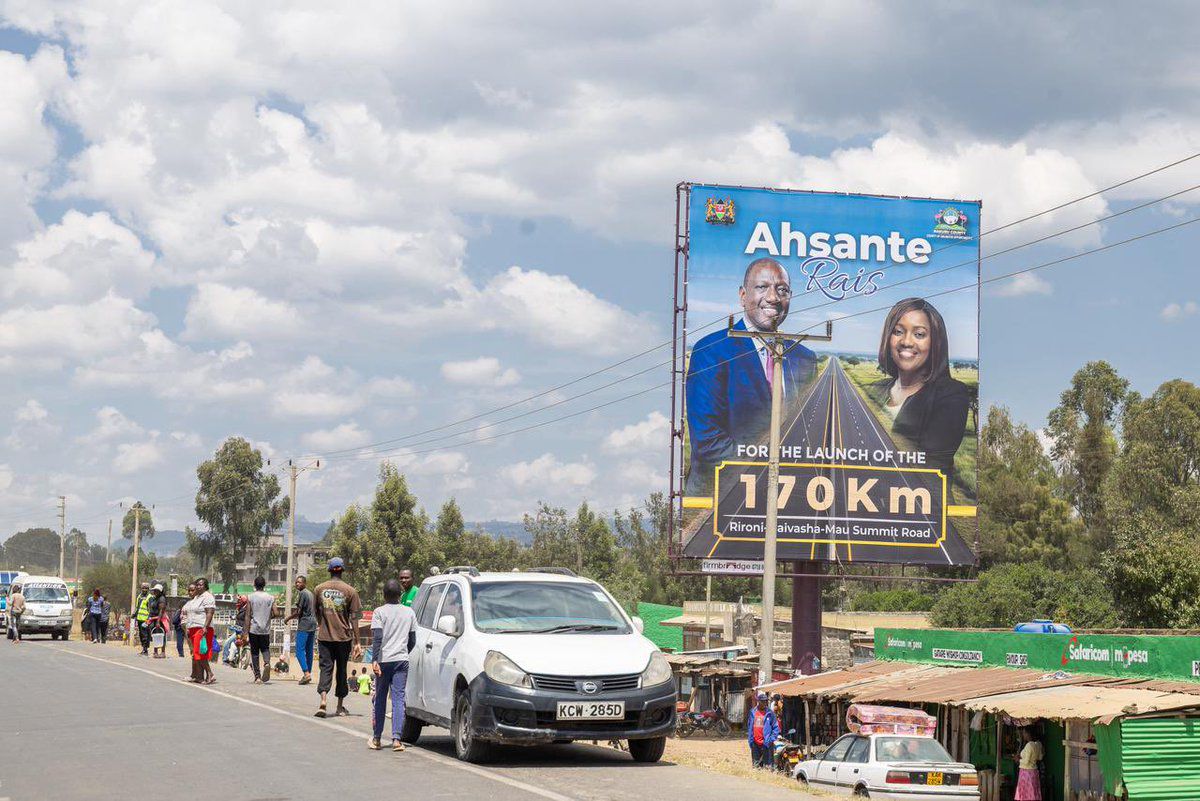
This story begins with a billboard in Nakuru and if the gods of narrative symmetry are pulling their weight, it will end with that same billboard. So walk with me gently, keep your eyes where I point them and don’t wander, because this terrain politics, money and the fragile ego of power is wide and full of distractions and it’s easy to get lost.
Somewhere between the noise of national celebrations and the hum of county politics, a giant billboard sprouted along Nakuru roadside Governor Susan Kihika thanking President William Ruto for launching the Rironi–Mau Summit highway. A towering, glossy monument of gratitude paid for, ironically, by the very taxpayers who probably didn’t ask to be involved in this public missive.
Predictably, Kenyans gathered in the village square called social media to poke, prod, joke and raise eyebrows. In a country where we debate everything fuel, football, funerals billboards were always going to be fair game. Some praised the gesture as political courtesy. Others wondered why thanking the president for doing his job suddenly required prime real estate and public money.
And I get it. Symbolism is a powerful thing in politics. Leaders love symbols handshakes that heal nations, flags that unite tribes, groundbreakings that promise futures. A billboard? It’s simply the modern political handshake large enough to be seen, vague enough to be misunderstood.
But here’s where the story wrinkles. Symbolic acts are only beautiful when they cost nothing or close to nothing. Once they begin to chew through public resources like a hungry goat in a flower garden, their charm evaporates. Suddenly the symbolism begins to smell a lot like self-praise, and worse self-praise funded by people who probably have better things to spend on. Like water, Or hospitals, Or roads that don’t moonlight as obstacle courses.
When a county government dips into public funds to thank the president, it blurs lines that should stay sharp. It turns governance into performance, duty into favour, and public money into decorative confetti thrown at the feet of power. It whispers a quiet message, “Look at us. We are loyal. We are grateful. Please remember us next time budgets are allocated.”
And the most concerning part? The public value in this entire stunt is thin. Did the billboard inform citizens about project timelines? No. Did it explain cost breakdowns? No. Did it hold anyone accountable? Absolutely not. What it did was immortalize a political courtesy that could have been delivered through a press release, a tweet or even a well-timed handshake.
Now, before we lose the plot, let me say this I’m not allergic to symbolism. It matters. It unites. It communicates. But it must never compete with public needs or masquerade as governance. A symbolic act paid for by taxpayers must earn its keep. It must tell them something useful, warn them about something important or guide them toward something meaningful not serenade power like a confused troubadour.
Which brings us back to the billboard. And Nakuru. And the governor. And the president. And the taxpayers who financed a message they didn’t write. The social and ethical cost here is simple every shilling spent on political aesthetics is a shilling not spent on public welfare. And symbolism, when weaponized for self-praise, becomes an ethical pothole one that swallows integrity, accountability and sometimes entire budgets.
In the end, county governments must understand a basic rule of political hygiene public funds should never be used to inflate egos, polish images or deliver political valentines. If symbolism is necessary, let it be cheap. If gratitude is necessary, let it be personal. If communication is necessary, let it be informative.
When leaders start erecting billboards to thank each other for doing their jobs, citizens are left wondering If this is what they spend on showing gratitude, how much do they spend on everything else?
And that is where this ends exactly where it began at a billboard that said far more than the words printed on it.