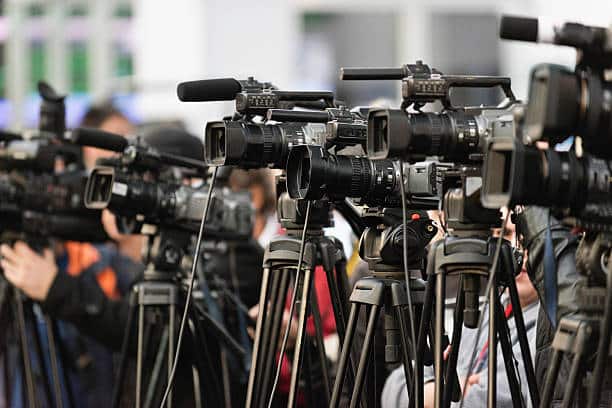
TV cameras lined up, covering large public event
Women long confined to the margins, are stepping into spaces traditionally dominated by men and reshaping the industry’s future. This transformation is not just about breaking barriers but about rewriting the rules of engagement and challenging entrenched stereotypes.
The journey is neither easy nor complete but it is both inspiring and essential. Kenya’s media has always been a powerful tool for shaping societal values and influencing public opinion. Historically, however, the sector has mirrored the patriarchal structures prevalent in society.
Women were often relegated to supporting roles such as news anchors, reporters or assistants, while key decision-making positions remained the domain of men. Even when women appeared in the limelight, their presence was often evaluated based on appearance rather than expertise. Such biases have perpetuated a limited, one-dimensional view of what women in media can achieve. Today, the winds of change are palpable.
Women are increasingly occupying roles that were once considered unattainable. They are leading newsrooms, directing influential programs and challenging societal norms through bold journalism. More than just reporting, they are shaping the discourse, bringing to light stories that would otherwise remain untold. Women journalists are championing investigative reporting, tackling issues like corruption, gender-based violence and societal inequities with courage and precision. This transformation is not without resistance.
The Kenyan media landscape, like many others globally, is still steeped in a culture that questions the authority of women in leadership. For every step forward, there are murmurs of dissent, questioning women’s competence, leadership styles and their ability to balance professional demands with societal expectations. Yet, these challenges have only fueled the determination of trailblazing women who refuse to accept mediocrity or limitation.
The impact of women in media goes beyond representation but about perspective. Women bring to the table unique experiences, insights and sensitivities that enrich storytelling. They highlight issues that often escape the male gaze such as maternal health, domestic violence, workplace discrimination and education for girls, among others. These narratives are crucial for fostering a holistic understanding of the challenges faced by different segments of society and for driving meaningful change. Redefining women’s roles in Kenyan media also demands a cultural shift within the industry. It requires creating environments that are not just inclusive but actively supportive of women’s growth.
Workplaces must address systemic issues such as pay gaps, harassment and lack of mentorship opportunities. Policies should be implemented to ensure women can thrive without compromising their personal lives. Leadership too must champion diversity not as a token gesture but as a fundamental pillar of organizational excellence. The rise of digital platforms has further democratized the media space, offering women a stage to amplify their voices and stories. Social media, blogs and podcasts are becoming powerful tools for women journalists to connect directly with audiences, bypassing traditional gatekeepers. These platforms have allowed women to curate content on their terms, challenging norms and fostering conversations around taboo topics.
This digital revolution is an equalizer, allowing talent and determination to shine through, regardless of gender. Moreover, redefining women’s roles in Kenyan media is not solely the responsibility of women. Men within the industry must also play an active part. Allies are essential to dismantle the structures that perpetuate inequality. Male colleagues and leaders must advocate for equity, challenge stereotypes and support their female counterparts in meaningful ways. Collaboration, rather than competition, will pave the way for a more inclusive media environment.
As more women step into leadership roles in Kenya’s media, they serve as beacons of possibility for the next generation. Young girls, watching these trailblazers on their screens or reading their bylines, are inspired to dream bigger. They see that their aspirations are valid, their voices are valuable and their potential is limitless.
Representation matters, it is the foundation upon which aspirations are built and societal change is achieved. The redefinition of women’s roles in Kenya’s media is all about excellence. It is also about recognizing that diversity in thought, experience and leadership enhances the quality of journalism. It challenges the industry to be more reflective of the society it serves.
This is not a battle to be won overnight but a continuous effort that requires persistence, innovation and collective will. Kenya’s media stands at a crossroads. The path forward is clear, it must embrace and amplify the contributions of women, breaking down barriers and smashing the glass ceiling. In doing so, it will not only create a more equitable industry but also a more vibrant, inclusive and impactful media landscape. The time for transformation is now and the women leading the change are proving that they are more than ready to redefine the narrative.