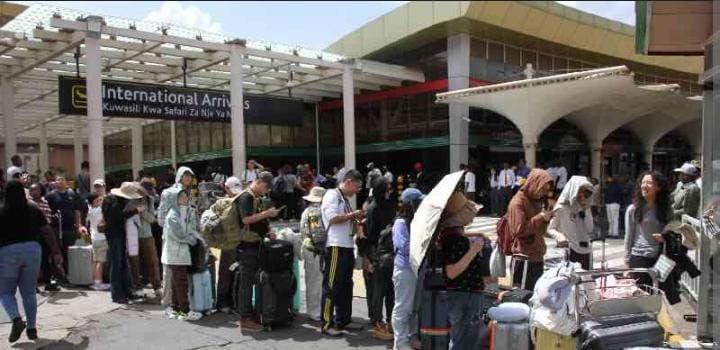
Passengers at Jomo Kenyatta International Airport (JKIA) and other airports in Kenya had to endure 48 hours of miserable flight delays when a nationwide air transport strike reduced the busiest transport hub in the region to a near standstill. The labor strike that was commenced on Monday, February 16, 2026, found hundreds of passengers stranded in the terminals because the flight schedules were disrupted under the pressure of a labor strike by a worker on a go-slow.
The Kenya Civil Aviation Authority (KCAA) was the major target of the strike that was led by the Kenya Aviation Workers Union (KAWU). The union, which represented the ground staff and the air traffic controllers, cited ten years of not reviewing salaries and the unwillingness to incorporate a long-awaited Collective Bargaining Agreement (CBA).
The situation at the JKIA was boiling by Tuesday morning: National carrier Kenya Airways reported up to four-hour delays on departures. Jambojet, a low-cost airline, had to cancel all the flights throughout its network, stating that it was caused by long ground holding times because of air traffic clearance. Departure halls in the airport were filled with angry travelers, as captured by the images. Cancellations and diversions were announced as regional carriers such as Ethiopian Airlines and Uganda Airlines issued notices to their customers.
On Tuesday, the Kenya Airline Pilots Association (KALPA) sounded the alarm, claiming that the air traffic control hitches were extremely dangerous to the airline in the Kenyan airspace. KAWU Secretary General Moss Ndiema said that the strike was a final measure following a seven-day ultimatum that had expired on Monday. The grievances of the workers are as follows: Claims that some workers have not had their salary reviewed within over 12 years, The union is seeking to have the contract workers transferred to permanent and pensionable members, In response to a court order, issued at the end of 2025, that is yet to be fulfilled, A challenge regarding whether to recognise workers in Grades 4 and 5 as unionisable employee.
Relief at last came towards the end of Tuesday afternoon, February 17. After a mediation session of high stakes was held under the chairmanship of Transport Cabinet Secretary, Davis Chirchir, KAWU accepted a formula of returning to work. The agreement, negotiated between the Ministry of Transport, the Ministry of Labour, KCAA, and KAWU, has the following: Immediate Resumption. Everything in the airport will resume instantly. KCAA accepted to immediately consider and incorporate Grade 4 and 5 employees in the union representation. The Ministry of Labour facilitated conciliatory action, which will solve the outstanding long-term pay and CBA.
Although the strike technically has ended, it will take days to clear the backlog. Airlines have cautioned that schedules will keep changing through the week as they rebook thousands of passengers who were affected. To the Kenyan government, the two-day paralysis is a good reminder of how weak peace in its critical infrastructure is.”Aviation contributes immensely to the economy,” Said Davis Chirchir. “We are committed to ensuring the sector remains stable.”