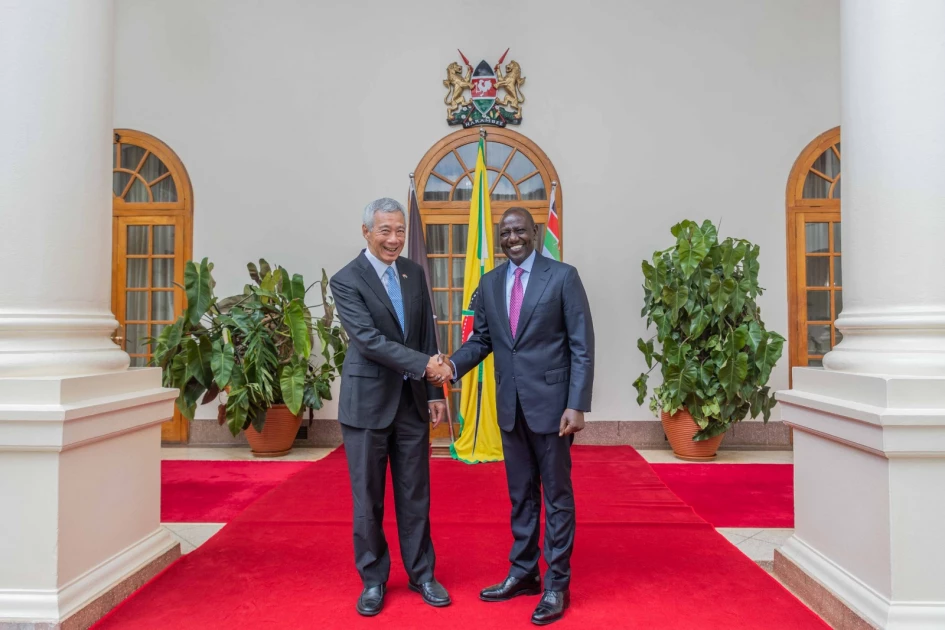
President William Ruto (R) pausing for a photo with Singapore PM Lee Loong during his visit to State House, Nairobi on May 18, 2022.
President William Ruto has on several occasions exposed his desire to change Kenya into a globally competitive nation. He even cites the example of Singapore, a tiny island state that changed from being a poor country to a wealthy one within the span of only one generation.
Although Kenya and Singapore differ in their size, geographical features, and population, the path Singapore took to development contains valuable lessons which Kenya can take advantage of.
To start with, strong institutions and an uncompromising attitude towards corruption constitute the backbone of Singapore’s success. The creation of investor confidence and public trust was the result of efficient public service delivery, merit-based appointments, and strict enforcement of the rule of law.
The case for Kenya is that it needs to go beyond mere words and put into practice concrete measures. For example, there should be a focus on the strengthening of independent institutions, the prosecution of corruption cases to the fullest extent of the law, and the ensuring of accountability throughout all levels of government.
Another important one is the development of human resources through education and training which turned Singapore into a knowledge-based economy. The educational system was designed in such a way that it facilitated the attainment of national development objectives, and thus increased technical skills, innovation, and discipline.
Kenya should do more to improve the quality of its education and training of the workforce, especially in the field of STEM and vocational areas, while at the same time adapting the content of education to the needs of the job market.
Thirdly, economic planning and industrialization had a huge impact on the development of Singapore. The city-state managed to turn itself into a manufacturing, logistics, and financial center through the making of deliberate decisions, investing in the necessary infrastructure, and making it easy for businesses to operate.
Kenya can do the same if only it committed itself to the full realization of its industrial parks, backed up the value addition in agriculture, enhanced the reliability of energy, and lessened the bureaucratic obstacles to businesses.
Fourthly, urban planning and infrastructure development were the main factors that allowed efficiency and livability to go hand in hand. In fact, Singapore had spent a lot of its money on transport, housing, sanitation, and digital infrastructure.
Kenya has to find ways of improving its urban governance, carrying out major transformations of the public transportation system, building up the stock of affordable housing, and incorporating technology into public services at the same time.
Lastly, the discipline of management and the long-term vision of leadership were the key factors that led Singapore to its present state of economic development. Policies were kept consistent even when there was a change in government.
If Kenya is ever to get to the same level as Singapore, then the issues of political stability, policy continuity, and inclusive growth should be the guiding principles of the national development process.
Thus, Singapore’s path serves as proof that a change for the better is not attainable through quick schemes but via discipline, integrity, and a sustained nationwide focus. The point at which Kenya stands is not that it lacks ambition but rather that it needs to do the work.